
Cornea DSAEK
Advanced corneal transplant surgery (DSAEK) for corneal disorders — restoring vision with precision, safety and faster recovery.
Cornea DSAEK
A modern, minimally invasive corneal transplant that replaces only the damaged inner layer of the cornea.
Research studies in India show that corneal blindness is one of the leading causes of blindness, with more than 10 lakh people blind in both eyes (2019). Corneal blindness can often be restored with a corneal transplant.
Healthy donor corneas, donated soon after death, are transplanted to replace the damaged cornea. As noted by Dr. Jugal Shah, corneal transplants are highly successful, but eye donation awareness remains low in the country.
Traditionally, full-thickness corneal transplants were performed. Today, DSAEK (Descemet’s Stripping Automated Endothelial Keratoplasty) allows selective replacement of only the damaged endothelial layer, preserving healthy corneal tissue.
What is the Cornea and Its Function?
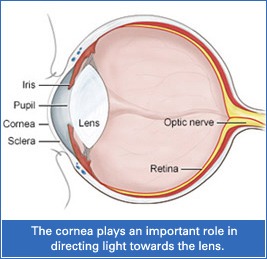
The human eye consists of three layers — sclera, choroid and retina. The front portion of the sclera is called the cornea. It is a thin, transparent tissue that covers the front of the eye and is the surface on which contact lenses sit.
The cornea plays a major role in bending (refracting) light and is responsible for nearly two-thirds of the eye’s focusing power. For clear vision, the cornea must remain smooth, compact and transparent.
If the cornea becomes swollen, scarred or cloudy due to disease or injury, vision can be severely reduced or completely lost. In such cases, a corneal transplant is the only way to restore vision.
What is DSAEK?
DSAEK is an advanced form of corneal transplant where only the damaged endothelial cells (inner corneal layer) are replaced, instead of replacing the entire cornea.
This technique uses a much smaller incision, requires fewer stitches, and results in faster healing and better visual recovery compared to traditional transplants.
How is Cornea DSAEK Surgery Performed?
In Descemet’s Stripping Automated Endothelial Keratoplasty, a healthy donor cornea is obtained. A thin layer containing endothelial cells is carefully prepared and inserted into the patient’s eye.
Once positioned, the donor tissue attaches to the patient’s cornea and begins functioning like natural endothelial cells, clearing corneal swelling and improving vision.
Since only a single thin layer is replaced, the chances of success are high and healthy portions of the cornea are preserved.
DSAEK is an outpatient procedure. The entire surgery typically takes 45–60 minutes, and no hospital stay is required.
Who is Eligible for Cornea DSAEK?
DSAEK is suitable only when damage is limited to the inner endothelial layer. Patients with deeper or full-thickness corneal damage may require a full corneal transplant.
Conditions Best Suited for DSAEK / DMEK
- Fuchs’ endothelial dystrophy
- Posterior polymorphous membrane dystrophy
- Congenital hereditary endothelial dystrophy
- Bullous keratopathy
- Iridocorneal endothelial (ICE) syndrome
- Failed previous corneal transplants
Recovery After DSAEK Surgery
Full recovery usually takes about three months. Vision is initially blurred and gradually improves within one to two weeks.
Patients are advised to lie flat on their back for the first few days to help the graft attach properly — typically 45 minutes out of every hour.
- Use prescribed antibiotic and steroid eye drops regularly
- Avoid rubbing or bumping the eye
- Wear protective eyewear when required
- Avoid swimming, diving and heavy lifting for some time
Risks of DSAEK / DMEK Surgery
DSAEK is a highly successful procedure. In rare cases, if the graft does not fully attach, a small procedure may be needed to insert an additional air bubble.
Serious complications such as infection, retinal detachment, haemorrhage or severe inflammation are extremely rare. Minor pupil shape or size changes may occasionally occur.
Why Choose DSAEK?
- Minimally invasive
- Faster visual recovery
- Higher success rate
- Preserves healthy cornea